
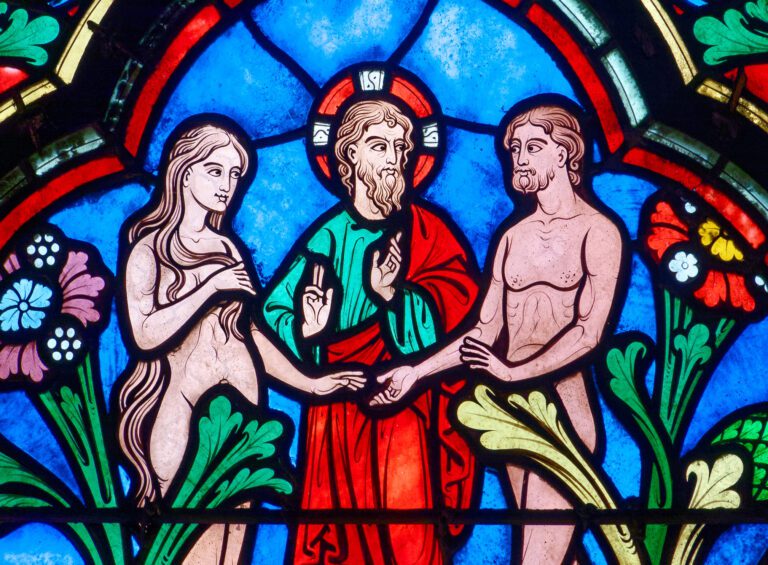
THE FIRST ADAM
Adam and Eve committed the first sin when they ate of the fruit of the tree of the knowledge of good and evil (Gen. 3:6). God told Adam that if he ate of it, he would receive the punishment from God of death (Gen. 2:17).
ALL the descendants of Adam would experience death due to the GUILT of Adam’s first sin (Rom. 5:12). All human beings have sinned; therefore, all human beings must die (Rom. 5:12). So, sin entered the world because of Adam’s first sin of eating the forbidden fruit (Rom. 5:12). The law had not yet come to the world (Rom. 5:13). As Augustine wrote in The City of God,
and created man with such a nature that the members of the race should not have died, had not the two first (of whom the one was created out of nothing, and the other out of him) merited this by their disobedience; for by them so great a sin was committed, that by it the human nature was altered for the worse, and was transmitted also to their posterity, liable to sin and subject to death.[i]
Not even Jesus can save humans from that (Rom. 6:23).
In other words, all Adam’s descendants die because of the guilt of the first sin, not because they actually committed the first sin (Rom. 5:18). This means that when the last human dies, it ends the human race, except that God, knowing this was inevitable, setup the plan of salvation for the elect and gave them to Jesus (Is. 53; Gal. 3:13) who would become a human being (Matt. 1:20, 21; John 1:9-18; Heb. 2:5-18) and be their surety (or guarantor) for salvation (Heb. 7:22, 25).
So, through the sin of Adam in the Garden of Eden, God, by cursing the offspring of Adam, the guilt of that sin was applied to all humanity (Rom. 5:12), except Jesus, of course. Adam, who was unable to fulfill all God’s commands and live a perfect life, was a type or a foreshadowing of Jesus. Adam failed to fulfill what some theologians call the covenant of works, but Jesus did fulfill it, and the elect would receive salvation.
THE SECOND ADAM, JESUS
Adam failed to adhere to God’s commands and sinned, thus causing all his descendants to live with the guilt of his sin and eventually suffer the penalty of death (Rom. 5:12-14). But God knew this would happen and in eternity past set up a divine plan of redemption (Eph. 1:4, 7; 2 Tim. 1:9). This would provide for a sinless person who lived a perfect life and who would die on the cross in payment for all the sins of the chosen ones, the elect, who then would receive eternal life with God (Eph. 1:4; Gal. 3:13; Titus 1:2, 3). Jesus was the antitype of Adam; He was the fulfillment of what some theologians call the covenant of works. The rest of humanity, the reprobate, would experience death forever.
Every human being, after Adam and Eve, was conceived in the biological way designed by God (Gen. 4:1). When God breathes a spirit into them at conception, each new human also receives the sentence of death caused by Adam’s first sin, and this spirit that God breathed into the newly conceived human being is called original sin. Therefore, all humans, except Jesus, were conceived into sin.
Now, this happens at conception, not birth. Humans become human at conception when God makes them a BEING by giving them a spirit and assigning original sin to them, not at birth (Jer. 1:5; Ps. 139:13). Babies who die before birth are nevertheless human beings. Otherwise, abortion would not be a sin. The way we know that this happens at conception is because these human beings, still in the womb, and others who are not of the age of reason, die. Thus, all these were subject to original sin, which had to come upon them before birth, namely, at conception. These humans have not yet reached an age at which God will hold them accountable for their sins. But they nevertheless die even though they have not actually sinned. Original sin was what caused them to die.
Also, if God made humankind with original sin, not only would Adam and Eve have it (which they don’t), but God would have made something bad, which He didn’t.
The law of the land, however, considers a human a being at birth, not at conception. Though civil law must be recognized by Christians civilly, they must consider the Bible correct and obey the law civilly as long as it doesn’t require them to violate their Christianity.
Jesus was conceived by the Holy Spirit (Matt. 1:18, 20). Therefore, Jesus could be the proper substitutionary sacrifice for the elect because He was not saddled with original sin like the progeny of Adam and Eve, and He lived a perfect life.
We have explained how Jesus the Messiah (or Christ) was to provide salvation for God’s chosen ones, but how was this salvation to be transferred to the elect?
THE ELECT
In eternity past, as part of the plan of redemption, God the Father chose certain human beings to be the elect or the chosen ones of God to receive salvation (John 15:16; Rom. 1:7, 8:33; Eph. 1:4; Col. 3:12; 1 Pet. 2:9). God the Father gave these elect human beings to the Son, Jesus Christ, as their surety for their salvation (John 10:29, 17:12; Heb. 7:22). God chose, before creation, those who would be the elect. The choice of salvation was God’s, not human beings.
The elect were chosen by God the Father in the past and will be brought to salvation through their belief in Jesus Christ.
All people are given the call to come to God by belief in the Messiah, Jesus of Nazareth. But the elect are dealt with individually, beginning with their regeneration (See John chap. 3), which is accomplished by the Holy Spirit, when God believes the time is right.
At a person’s regeneration, they are changed from having a depraved heart, which means they can only sin against God, to a heart that can choose to sin or not sin, and to one that can seek God. Then, after hearing the gospel, repenting of their sins, and receiving God’s free gift of saving faith, the elect person believes in Jesus and is justified and adopted by God as His child. This happens for every one of the elect or chosen ones.
The belief in Jesus Christ by the elect is a belief in everything true about Jesus, His life, works, and beliefs. The Bible contains everything we need to know about God and Jesus Christ.
CONCLUSION
So, the first Adam was not able to comply with what some theologians call the covenant of works. He did not live a sinless, perfect life. But Jesus Christ, the second Adam, was sent to earth in human form to be the surety for all the elect that God chose before the world was created. Jesus Christ did fulfill the covenant of works, and all the elect whom God chose before the foundation of the world will be saved.
The Apostle Paul tells us that much more people will be saved by the grace of God, which abounded for many, than the many who will go to hell for their transgressions (Rom 5:15).
[i] St Augustine, The City of God, Trans. Marcus Dods (Digireads.com Publishing, 2017), 373.
