
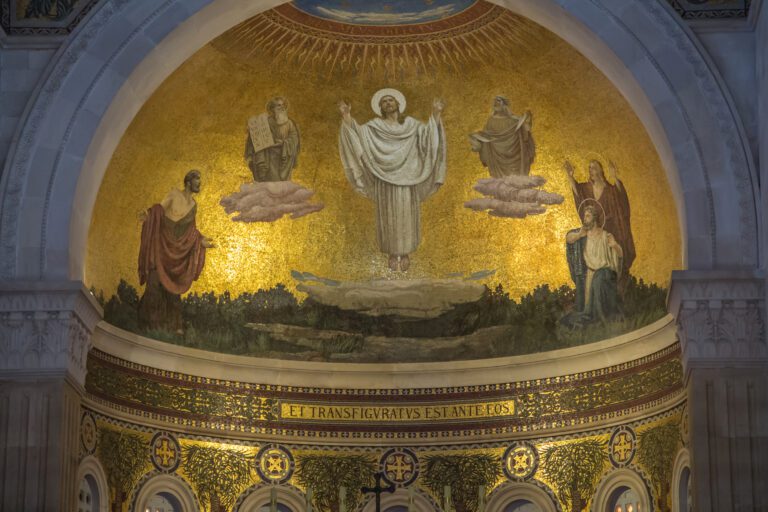
Matthew 17:1-9, Mark 9:2-9, and Luke 9:28-36
The Transfiguration of Christ is found in the three synoptic gospels and nowhere else in the Bible. According to sacred scripture, followed by three of his disciples, Matthew, Mark, and Luke, Jesus ascended onto a mountain where He showed them His divine glory for the first time on earth. The biblical account of this is found at Matthew 17:1-9, Mark 9:2-9, and Luke 9:28-36. It is those accounts of the Transfiguration that present the facts of it to the readers of the Bible. Theologians have studied these scriptures throughout the ages to determine their actual meaning.
CONTEXT
Jesus had been ministering, teaching, and performing miracles up to this point in His ministry. About a week after Peter’s proclamation in response to Jesus’s question, “You are the Christ, the Son of the living God” (Matt. 16:16; Mark 8:29; Luke 9:20), the Transfiguration occurred.
Jesus commended Peter for saying this, but he told all the Disciples with him not to tell anyone that he was the Messiah (Matt. 16:20; Mark 8:30; Luke 9:21).
Now and until the transfiguration, Jesus sought to prepare his disciples for what would happen to him in Jerusalem. He told them that he would be killed by the Jews, but that His resurrection would occur on the 3rd day (Matt. 16:21; Mark 8:31; Luke 9:22).
Peter disagreed with Jesus about this and took him aside, rebuking him for saying such things (Matt. 16:22; Mark 8:32). But Jesus told Peter that the devil was causing him to say that (Matt. 16:23; Mark 8:33). Instead, Peter should set his eyes on the things of God, not on things of man (Matt. 16:23; Mark 8:33).
THE TRANSFIGURATION
Jesus had already told his disciples that He would come in glory with his angels and, at that time, repay every person according to his actual works (Matt. 16:27). This set the stage for the glory of Jesus that the three disciples saw during the transfiguration.
About a week later, after entering “the district of Cesaria Philippi,” He took three of his disciples, Peter, James, and John, with him on a journey to the top of a mountain (Matt. 17:1; Mark 9:2; Luke 9:28). It was there that Jesus was transfigured (Matt. 17:2; Mark 9:2).
During the transfiguration, Jesus’s appearance changed. Matthew’s account says that “his face shone like the sun, and his clothes became white as light” (Matt. 17:2). Mark says, “his clothes became radiant, intensely white, as no one on earth could bleach them” (Mark 9:3). Luke said “his clothing became dazzling white” (Luke 9:29). His glory was the Shekinah glory (Luke 9p:32). This extrabibical Hebrew word that was made-up by Jewish rabbis is the sign of the divine.
Reformed theology thinks about the hypostatic union, which holds that Jesus’s two natures, divine and human, are not mixed or changed in any way. They are distinguished from one another, not separated. He is fully God, and He is fully human. Jesus only veiled His divine nature for a period of time; He didn’t abandon the divine nature He had in heaven. He kept it hidden until the time was right.
We are told that Moses and Elijah were present, but it does not describe their clothes, indicating that they were dressed as they would normally. Jesus was speaking to them in heaven, so the two men were in their glorified bodies, like everyone else there. Some commentators believe, and I do also, that the two men represented the law and the prophets, respectively.
Then they saw a cloud, and a voice came from it saying that Jesus was His (God, the Father) Son, and they should listen to Him. This was God and divine, too. The three disciples were terrified, and Peter offered to build three tents for them. But the disciples looked around, and the two men were gone, and the transfiguration was finished.
A proper understanding of these verses, therefore, is that, though Moses and Elijah were glorified as humans would be, Jesus was cloaked in the glory of God because He was God, and God, the Father, was also surrounded by that divine glory.
This makes it definitive—Jesus is God.
WHAT THE TRANSFIGURATION TEACHES
The transfiguration of Jesus told the Apostles and teaches all Christians that Jesus was, in fact, God. He lived on earth as a human being, but when he was transfigured, we saw that He was God. The Transfiguration was one of the steps in preparing Him and His apostles for the Passion Week that was to come—the death, burial, and resurrection of Christ.
Another thing it teaches Christians is that there is suffering before there is glory in heaven. Also, the Apostles and the rest of us Christians realize, if we didn’t already know it, that Jesus was in fact God himself. We are taught not only to look for Jesus’s glory, but also to be transformed, to be renewed in spirit, to be like Jesus (2 Cor. 3:18).
The transformation of Jesus Christ teaches Christians that during our journey in this life, we are not only to look forward to the glory of Jesus but to become renewed in spirit, realizing that during our sanctified walk with God, there will be trials and tribulations, and our journey is progressive, but ultimately we will be in heaven with God to live forever.

1 comment
page
Howdy I am so thrilled I found your blog page, I really found you by mistake, while I was searching on Askjeeve for something else,
Anyways I am here now and would just like to say many thanks for
a fantastic post and a all round entertaining blog (I also love the theme/design),
I don’t have time to browse it all at the moment but I have bookmarked it and also added in your RSS feeds, so when I have time
I will be back to read a lot more, Please do keep up the awesome jo.