
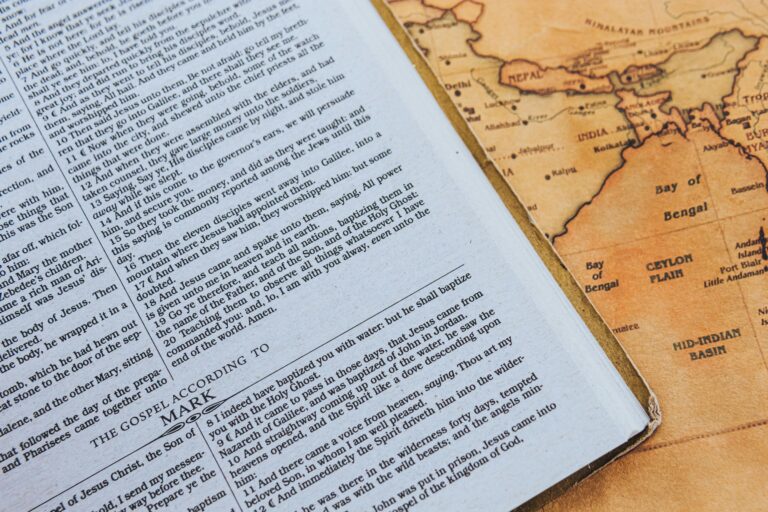
Many who have studied the book of Mark believe that Mark actually ended at verse eight and that verses 16:9-20, which include the Great Commission, were added by someone else, maybe a copyist.[1] Therefore, this article will focus only on Matthew 28:16–20.
Jesus Christ’s death, burial, and resurrection are foreshadowed in the Old Testament, particularly in Psalm 22. So, Jesus fulfills the Old Testament foreshadowing in the New Testament through His death, burial, and resurrection.
Dr. Bruner, in his commentary on the book of Matthew, writes the following.
Thus, the Commission’s outline is simple. After the Preamble, vv. 16–17:
- The Commanding Authority, v. 18
- The Commanding Mission, v. 19a
- Baptism v. 19b
- Teaching, v. 20a
- The Commanding Presence, v. 20b[2]
Although other outlines are available, this one is sufficient for this article.
In the Preamble, readers of scripture are told that the eleven apostles went to Galilee on Christ’s orders (Matt. 26:32). The word translated as ‘disciples’ in verse 16 refers to Jesus’ eleven apostles, though it can and is sometimes translated as ‘followers.’ Remember, there were only eleven apostles because the betrayer, Judas, was not present (Acts 1:25). The angel and Jesus also told the women disciples of Jesus to go there (Matt. 28:7, 10). The women first worshiped Jesus, then went to His disciples to tell them of the resurrection and that He would meet them in Galilee, as the angel told them (Matt. 28:7) and as Jesus had told them before (Mark 14:28). Verse 17 tells us that in Galilee, when they saw the resurrected Jesus, they worshiped Him. But we are also told that some of the people present doubted Him. Of the 11 apostles, Thomas was the only one who didn’t believe, but later would believe (John 20:24-29).
In verse 18, Jesus, in His human nature as the Son of God, told His apostles that the God of the universe had given Him ALL authority over ALL things. The Son of God, like the other members of the Trinity, has all authority over all things naturally in their divine nature. But human nature must be given all authority over all things by God.
As you remember, the Son of God was the only person in the Trinity to have two natures: a human one and a divine one. These natures were forever connected and could not be separated, yet they were not mixed or confused with one another. However, since Jesus had a connection with his divine nature, he was fully man and fully God. This is the commanding authority that Bruner mentioned in his outline.
In verses 19 and 20a, we have the actual meat of The Great Commission. It reads “Go therefore and make disciples of all nations, baptizing them in the name of the Father and of the Son and of the Holy Spirit, teaching them to observe all that I have commanded you.
Jesus gave the Great Commission to His Apostles, but it was intended for the entire body of Christ, the Church. First, one who wanted to become a believer had to come to Jesus, and then the Christian was to go and evangelize the world. In light of this, a discussion of the Church’s founding will appear later in this article.
The eleven apostles were in Galilee, but it was in Jerusalem that the evangelization of the world was to begin (Acts 1:8), first with the Jews and then with the Gentiles (Rom. 1:16), and it was in Jerusalem where the Church began.
The Bible indeed teaches coming to Jesus and having fellowship with other Christians, but the Great Commission, in verse 19, teaches Christians to GO out from the Church. We are taught that, just as Jesus did while living on earth, Christians should go out to all nations to spread the good news of Christ.
The Church was founded when the Holy Spirit came upon the eleven and others on the Day of Pentecost, a Sunday (Acts 2:1-4). The number of disciples (or ‘followers’) of Jesus increased, and the Church continued to grow (Acts 5:7, 6:1).
As the Church grew, it became more than the apostles (now 12 again due to the apostles selecting Mathias to replace Judas [Acts 1:26]) could handle if they were to continue preaching the word (Acts 6:2). The apostles chose seven men who were “of good repute, full of the Spirit and of wisdom” (Acts 6:3). Stephen was one of them. He would later become the first Christian martyr for Christ.
Saul, a Jew, approved of Stephen’s stoning and death. This same person, known at the time by his Greek name Saul, would later be known by his Roman name Paul (Acts 13:9). Paul would become an apostle and a great evangelist for the Church (see Acts chapter 9).
A great persecution of the Church occurred after Stephen’s death. The Church was scattered from Jerusalem. The first Christian missionary who went to Samaria was Philip. Many more followed to this day.
After the word ‘go’ in verse 19, the next word is ‘therefore’. So what does this mean? It refers to the authority Jesus has been given, which is written in verse 18. Jesus is worthy of this authority and can order Christians to do things and make promises to them.
In verse 19, Christians, who are disciples or followers of Jesus, are told to ‘make disciples.’ They are ordered imperatively. The Christian is not ordered to convert people, for God does that. They are only commanded by Jesus to present the gospel to others. Jesus commands Christians to make known to all people the gospel of Jesus Christ, so that their minds and wills are inclined toward Jesus.
Jesus, the Messiah, is given dominion over “all peoples, nations, and languages” (Dan. 7:14). When the Great Commission says that Christians should go to “all nations,” it refers to Jesus’ authority and dominion over all human beings on earth.
Christians do not know who is or isn’t saved, so Jesus tells them to share the gospel with everyone.
Jesus orders Christians to do more than make disciples. Verse 19b tells us to baptize them in the name of God. The scripture actually says, “in the name of the Father and of the Son and of the Holy Spirit.” Christians are to baptize new Christians in the name, singular not plural, of God in its three persons. But God is singular. The three persons of the Godhead are listed, but it is intended to be one God, not three.
In Hebrew, the phrase that is translated “in the name of” means everything about the person. When we are told to do something in someone’s name, we are forming a union with everything about that person. So, in Scripture, when we are told to be baptized in the name of the Father and of the Son and of the Holy Spirit, we are being told to form a union with God, whether we say it in the name of God or we use the three persons of the Trinity.
Verse 20b orders Christians to not only make disciples and baptize them in the names of the three persons of the Trinity, but they are ordered to teach the new Christian all about the life and works of Jesus Christ. They are to teach the full gospel contained in the Holy Bible to every person who becomes a Christian. Every Christian, not just the preachers and teachers in the church, must be a witness–bearer for Christ.
Finally, Jesus makes it clear that He will always be with us until He returns the second time. This is the Commanding Presence of v. 20b that Dr. Bruner’s outline mentions.
As we read this and consider The Great Commission, we must understand that the eleven apostles were the same before Jesus’ Great Commission as after, and the same as all Christians past and present. They had no extra gifts, power, offices, or titles, etc.[3] These men were like all Christians except for their closeness to Jesus.
The Great Commission, given by Jesus Christ to all Christians, is to spread the gospel to everyone who would hear it. But if any person does not receive the Christian or listen to the gospel, go to the next person (Matt. 10:14; Mark 6:11; Luke 9:5). However, if that person commits to Jesus Christ, Jesus commands Christians to baptize and teach them everything about the gospel, and that He will always be with us until we arrive in heaven.
[1] R.C. Sproul, gen. ed., The Reformation Study Bible, Rom., n. 16:9-20, 10, (Reformation Trust Publishing, 2015 (ESV)), p. 1773.
[2] Frederick Dale Bruner, Matthew: A Commentary, revised and expanded edition (Eerdmans, 2004), p. 805.
[3] Frederick Dale Bruner, p. 832.
