
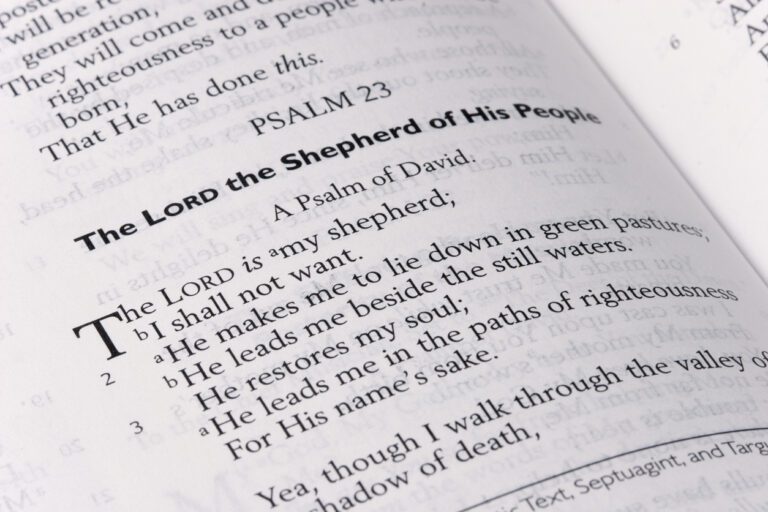
One of the most familiar chapters in Scripture is Psalm 23. Most scholars believe that it was written by David. But it is not often preached on. The purpose of this article is to present an exposition of this work.
When David wrote this Psalm, he knew God as the ‘shepherd.’ In fact, God was said to “tend his flock like a shepherd” (Ps. 23:1, 34:10; Is. 40:11). His people were dependent on Him for sustenance and protection.
Jesus was revealed as the ‘good shepherd’ in the New Testament, fulfilling Old Testament Scripture (John 10:11). Psalm 23 was fulfilled in the New Testament in the incarnate Son of God, Jesus of Nazareth (John 6:35; Heb. 13:20; 1 Pet. 5:4).
As Matthew Henry wrote, “Many of David’s psalms are full of complaints, but this is full of comforts, and the expressions of delight in God’s great goodness and dependence upon him. It is a psalm which has been sung by good Christians, and will be while the world stands, with a great deal of pleasure and satisfaction.”[1]
EXPOSITION
Verse 1: “The LORD is my shepherd; I shall not want.”
A shepherd is one who tends sheep. Here, David refers to Jehovah, God, as a shepherd. The shepherd supplies all that a member of his flock needs. That includes nourishment, shelter, and protection. In this verse, David refers to God as the one who supplies everything he needs in life. This also applies to us Christians today. The first verse of Psalm 23 could be rewritten to say “The LORD, Jehovah, is my personal shepherd and because of that I shall not want for anything.” This was really what David was writing.
Charles Spurgeon wrote that David “takes God to be his Provider, Preserver, Director, and, indeed, his everything.”[2]
God as shepherd to human beings is different from God as shepherd to beasts. Not only does God supply every physical need, but He also meets our emotional and spiritual needs. Just as the shepherd provides for the sheep, God provides for every need of human beings.
This is spoken of in the Old Testament, where it is foreshadowed (Ezekiel 34:7–16, 23) as God being the shepherd. In John 10:11–18, the story is told that Jesus is the good shepherd for the Church and fulfills the Old Testament.
This does not mean that believers in Christ don’t want anything. The scripture is saying that God and Jesus are all we need. As Christians, we are given everything we need to make our souls complete. This is not saying that we will prosper if we believe in the gospel, though prosperity can and will occur in certain things. God and Jesus will give us everything we need in life, though we may never have everything we want.
Verse 2: “He makes me lie down in the green pastures. He leads me beside still waters.”
As John Calvin has written in his commentary on Psalm 23, verses 2-6 explain the last clause of the first verse, “I shall not want.”[3] God gives us Christians this type of prosperity, which leads us to what comes next.
The only fear that Christians should experience is the fear of God. But human beings, including Christians, naturally experience other fears. They experience the fear of not having enough to eat, of no shelter, of a lack of protection, etc.
God gives believers what they need physically and emotionally, and He provides a place and time for rest in God for the Christian’s benefit, spiritually. Everlastingly, God provides His children with food, clothing, shelter, and protection as needed, as well as a time to seek God’s rest and peace. The reason for this is given to us in the next verse.
Verse 3: “He restores my soul. He leads me in paths of righteousness for his name’s sake.”
Because of what God promised in the previous verse, our souls were restored. Also, we were provided with care, shelter, food, water, and spiritual blessings. It is the physical care and comfort we receive that is mentioned in verse 2, which leads to our spiritual refreshment in verse 3.
God provides our sustenance for our physical bodies, and He refreshes our souls so that we are ready to walk the paths of righteousness. Then, we are ready to be led by God to the paths of righteousness, and He directs us as we walk along this path. Without His guidance, we would go astray and not stay on the path of righteousness. This is something we could not do alone; He must guide us.
Christians must understand that we must rest in God and be in Christ before we start the activities required of the Christian. We should be careful not to put the cart before the horse. We are to rest first in Christ and learn from the revealed word of God before we try to exercise our duties as Christians.
Remember that as Christians, we are to worship God first and foremost. It is only after this that we go out as Christian missionaries, evangelists, etc. It is essential that we do the work of a Christian, but we also have a duty to know and understand God first.
Verse 4: “Even though I walk through the valley of the shadow of death, I will fear no evil,
for you are with me; your rod and your staff, they comfort me.”
In life, all human beings face dangers and afflictions. Life is not a bowl of cherries. God is not telling us that we will not see persecution and bad things in life. Human beings are constantly in danger of death, but the true believers are under the protection of God. Though they are exposed to the problems and enemies common to all human beings, believers are also under God’s protection.
Although Christians have a healthy fear of God, they have no need under God’s protection to fear the evil that surrounds them in life. The Hebrew word רַע, which is transliterated as ra` (pron. rah), means in verse 23 evil, distress, or adversity. Christians may experience these things in life, but we must understand that they are temporary and that we are always under God’s protection.
God provides for Christians during this life, and the evils that we must see and experience are but temporary. It is the presence of God and His providence that is always there and permanent.
Verse 5: “You prepare a table before me in the presence of my enemies; you anoint my head with oil; my cup overflows.”
Now, David uses the metaphor of the table and the cup. It is a symbol of a Christian’s relationship with God. Because of this fellowship, God will always provide for our physical and spiritual needs. It is a one-to-one relationship between the individual Christian and God. It is a fellowship.
All Christians have enemies, as God does. But having believed in Jesus Christ, we should be calm even in the face of our enemies because of what God has shown us. He continually provides what we need body and soul, and we have fellowship with Him, which is the meaning of the table and the cup, and genuine Christians will do so even in the face of our enemies.
The table He provides for us is abundant for our physical lives, and it is also abundant for our spiritual lives. The children of God are continually looked after and treated by God as kings because of their belief in the Messiah. There is enough given to us, so it will cover the needs of others, too.
To anoint one’s head with oil is to prepare the person for a kingdom. Samuel was ordered by God to do this (1Sam. 16:1). By our belief in the Messiah Jesus, we are members of a kingdom, the Kingdom of God, which is evident on this earth and will be fully consummated in the hereafter.
No matter the Christian’s trials and tribulations, God will always abundantly provide for us, allow us to enter the kingdom of God, and partake of His blessings.
Verse 6: “Surely goodness and mercy shall follow me all the days of my life, and I shall dwell in the house of the Lord forever.”
David speaks of the joy of our personal relationship with God in this life in verse 6.
God’s provision and protection, both physically and spiritually, will be present for Christians for the rest of their lives. Because believers have a special, personal relationship with God, a fellowship, we can expect that He will care for us forever. That’s what the first part of verse 6 teaches us.
The “house of the LORD” in verse 6 refers to the kingdom of God.
LORD in verse 6 means the triune God of Christianity.
David is not just guessing that God will care for and protect him for the rest of his life. He knows for sure, based on it being God’s promise, that God’s goodness and mercy will never fail towards him for the rest of his life.
The continuance and stability of God’s goodness and mercy will follow David for the rest of his life on earth. David is certain, absolutely certain, that God’s promise will be fulfilled in his life.
CONCLUSION
David uses the metaphor of the shepherd in the 23rd Psalm. God is his shepherd, in verses 1-4. Then in verse 5, he depicts his personal fellowship with God as he walks through life as a justified sinner, with the metaphor of the table and the cup. This represents the blessings he receives from God. In verse 6, he tells us that God’s “goodness and mercy” will follow him for the rest of his life, and that he shall be in “the house of the Lord” (a member of the Kingdom of God) for the rest of his life.
David writes this psalm with great pleasure. He claims to have a personal relationship, a fellowship, with God, and he writes of the blessings he receives from God as a result of God shepherding him through life. He tells us that he wants for nothing, fears God, and promises that, because of those blessings, he will not leave God. David’s certainty of what God promised is evident in this psalm.
Jesus is said to be the “good shepherd” in the New Testament (John 10:11, 14-17). David foreshadows the great shepherd, God, as bestowing His blessings on him, while at the same time he forecasts the fulfillment by Jesus in the New Testament, where Christians receive the blessings of the care of the good shepherd, Jesus Christ.
Psalm 23 speaks of fellowship with God and with Jesus Christ. It does not speak of a religion per se; it speaks of the relationship, which is a fellowship with God forever.
[1] Matthew Henry, MATTHEW HENRY’S COMMENTARY on the Whole Bible (Hendrickson 1991), P. 257.
[2] Mark Water, Parallel Classic Commentary on the Psalms (AMG 2005) p. 94.
[3] Mark Water, p. 95.
