
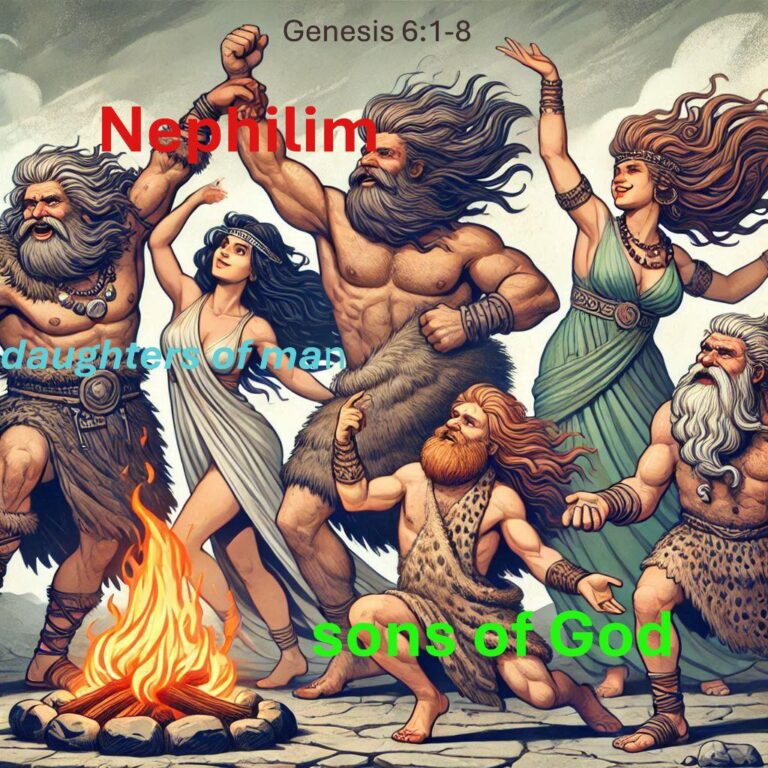
One of the most difficult passages of Scripture to interpret is Genesis 6:1-8. This portion of the book of Genesis is found just before the account of Noah and the Flood. In these verses, we are told of the ‘sons of man’ coming into the ‘daughters of man’ in a manner that seems to involve sexual relations. There is also mention of the ‘Nephilim,’ which has been interpreted as ‘giants.’
This article focuses on correctly understanding this passage, including the proper meaning of the following expressions: sons of God, daughters of man, and Nephilim.
SONS OF GOD
The phrase sons of God occurs five times in the Old Testament (Gen. 6:2, 4; Job 1:6; 2:1; 38:7) and five times in the New Testament (Matt. 5:9; Luke 20:36; Rom. 8:14, 19; Gal. 3:26). The meaning of this phrase seems to be different in the Old Testament compared with the New Testament.
The Hebrew phrase translated as sons of God in each case in the Old Testament is
The Hebrew phrase translated as sons of God in each case in the Old Testament is
The Hebrew phrase translated as sons of God in each case in the Old Testament is בְנֵי־ (ḇə-nê-) ōהָֽאֱלֹהִים֙ (hā-‘ĕ-lō-hîm,), which may be translated literally as “the male offspring of the God.” When trying to understand the phrase ḇə-nê-hā-’ĕ-lō-hîm in Genesis 6:2 and 6:4, one must ask whether it means the same as the exact words found in three verses in the Book of Job. In Job, we correctly understand this phrase to mean demons or fallen angels.
The word בְנֵי־ (ḇə-nê-) or ben usually means male offspring; however, in Genesis 6:2 and 6:4, it does not refer to a biological relationship or association but to a spiritual relationship with God. The term ‘sons of God’ refers to fallen angels in the Book of Job, but in this context, the word ‘sons’ does not have a supernatural connotation as in Job. It refers to a supernatural spiritual ‘relationship.’ The relationship is that of a child of God, or, more specifically, a son. So, it’s not the ‘sons’ who are supernatural but their relationship with God that is supernatural. Not only were these ‘sons’ created by God, but these particular sons have also been chosen by God as his children for eternity.
In the New Testament, the Greek phrase used in all five verses is υἱός huios (hwee-os’), meaning ‘sons’ and θεός Theou (theh’-os), meaning ‘God.’ This phrase refers to men’s relationship with God. So, the phrase “sons of God” in the New Testament refers to Christians.
In the Book of Job, “sons of God” refers to fallen angels. So, does Genesis 6 refer to angels, fallen angels, or humans? We know that angels do not marry (Matt. 22:30). Since Genesis 6:4 seems to say that the sons of God have sexual relations with the daughters of men, we cannot say that the sons of God are angels. Angels have no sexual aspect to their nature. There can be no sexual desire in angels for any creature. Furthermore, angels are spiritual beings and thus cannot have physical relations with humans. Moreover, as discussed elsewhere in this article, the daughters of man were definitely human.
The Bible uses the phrase sons of God as a utilitarian term in that the word translated as “sons” may refer to any of God’s creatures. Since angels, fallen angels, and humans are all beings created by God, they can all be in view when the term sons of God is used, depending on the context. In the New Testament, the context is undoubtedly children of God, referring to human beings. In Job, the context dictates that the term refers to fallen angels.
In Genesis chapter 6, the context indicates that the sons of God are men who are children of God. It fits the context of godly men marrying pagan women quite comfortably, and it avoids the strained mythological hermeneutics of fallen angels marrying human women.
DAUGHTERS OF MAN
The word ‘man” in Genesis 6:1 (as well as in verses 6, 7, 8) is translated from the Hebrew הָֽאָדָ֔ם
hā-’ā-ḏām and means ‘humankind.’ In verse 2, we find the term daughters of men. This phrase is translated from the Hebrew בְּנ֣וֹת, bə-n -wṯ, bath (pron. baht). This term in the Bible means daughter, the female offspring of human beings.
So, the phrase “daughters of man” refers to the female offspring of the human race at that time.
NEPHILIM
The word translated as Nephilim (‘giants’ in KJV) in Genesis 6:4 is the masculine, plural noun meaning “bully” or “tyrant.” This Hebrew phrase, הַנְּפִלִ֞ים, consists of the words han, which is the definite article ‘the,’ and nə-p̄i-lōm, which is the masculine, plural noun nephîl (pron. nef-eel’). The word nə-p̄i-lîm is translated as ‘giant’ only three times in the Bible.
Later, in verse 4, this group of men, referred to as the Nephilim, is called ‘mighty men.’ The phrase translated ‘mighty men’ (in Gen. 6:4) is הַגִּבֹּרִ֛ים hag-gib-bō-rîm. Hag is the definite article ‘the.’ And gib-bō-rîm is the plural, masculine adjective meaning strong/mighty man. Only once in the Bible is it translated as ‘giant.’ It comes from the root word geber, which means ‘valiant man or warrior.’
Both nə-p̄i-lîm and gib-bō-rîm, as used in verse 4, refer to a group of male human beings whose characteristics and reputation include such adjectives as strong, tyrant, bully, valiant, and mighty. These words confirm that the people are males because the word forms used are the masculine gender. They refer to ‘groups’ of men since the word forms used are plural.
A form of the word gib-bō-rîm is used in Genesis 10:8 to describe Nimrod as the first of these mighty men. As a result of the Fall, some human beings misused their God-given ability to rule over other creatures and instituted a regime of brutal force and violence. The terms nə-p̄i-lîm and gib-bō-rîm describe not giants but a class of brutal ruling men who dominated the antediluvian period between the Fall and the time of Noah and the Flood.
The spies sent by Moses into the Promised Land are also mentioned in Numbers 13:33, where ten of the twelve (Caleb and Joshua excepted) gave a very negative report of the Promised Land. They spoke of very large people and called them Nephilim, the sons of Anak. Caleb and Joshua had a positive report but didn’t mention Nephilim or the sons of Anak. The majority report of the spies was probably hyperbolic and incorrect, as was later found when the Israelites entered the Promised Land.
Therefore, the phrases translated as “Nephilim” and “mighty men” refer to strong, oppressive, ruling men who governed during the antediluvian period. They were not giant-sized human beings.
FALSE INTERPRETATIONS
There are a couple of false interpretations of this passage. One view identifies the sons of God as demons or fallen angels, which involves a misinterpretation of the phrase “sons of God.” Another view is that the sons of God were the godly descendants of Seth, who intermarried with the evil female descendants of Cain, but this view is pure speculation and has no support in Scripture. Many of these false interpretations also identify the Nephilim as giants.
We have discussed earlier the identity of the sons of God, the daughters of man, and the Nephilim. So, there is no need to recapitulate that discussion here.
CONCLUSION
During the antediluvian period from the Fall to the Flood, the Nephilim, or mighty men, were present in the world. These powerful warriors were oppressive, ruling their areas of influence by brute force. They were not giant-sized human beings. They were “giants” among men and possessed the reputation to dominate others. Those who interpret this passage as stating that giant human beings existed at that time are wrong.
The sons of God are introduced as men who were god-fearing but saw the pagan women as attractive and intermarried with them. This resulted in those god-fearing men accepting the pagan ways of the women. As a result of this intermarriage, the number of god-fearing humans significantly decreased, which displeased God. So much was God grieved by this that He decided to “blot out man.”
God determined to accomplish this using a flood. At the time of the Flood, only Noah and his family, seven in all, were children of God. He saved the eight godly humans on the Ark, and all other human beings and every living thing on Earth were destroyed.
We infer from Scripture tōhat the reason God included the discussion about the intermarrying of the godly men with the ungodly women in this passage is to show that a husband and wife should not be unequally yoked and that believers should not marry unbelievers because of the adverse effect such a union would have on families (cf. 2 Cor. 6:14-16). There is no reason to include details of this intermarrying unless this was significant in and of itself.
Another reason seems to be that God wanted to show why the earth was so thoroughly depraved. Ordinarily, there should be godly communities and ungodly. So, he included this to show the reason for the near-complete dominance of the ungodly. Marriage with heathen women will inevitably lead to a jettisoning of the godly elements of the children of God, resulting in a depraved state for all involved. Thus, here, too, intermarrying has significance to believers then and now.
