
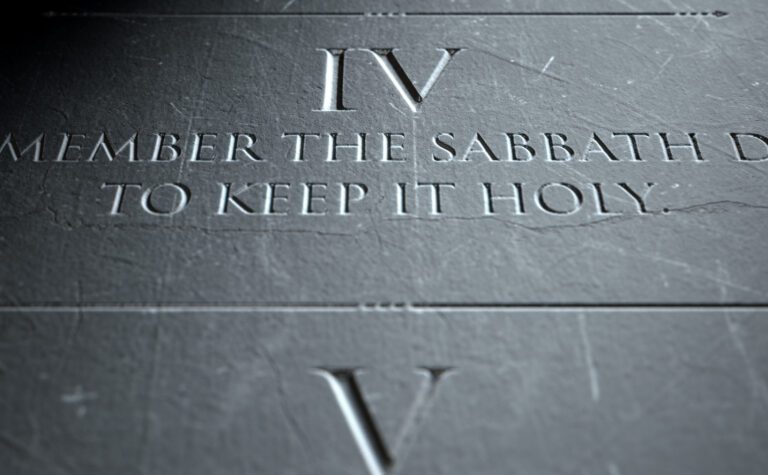
The word ‘sabbath’ appears over a hundred times in Scripture. A sabbath occurrence is described in Leviticus 23:24, 32, 39 as a time of rest during the Feast of Trumpets, the Day of Atonement, and certain days of the Feast of Tabernacles. But theSabbath is not ‘a sabbath’ but is the day of rest when the Israelites are commanded to rest and worship God (Ex. 31:12-17). It is not just a day off for them, but a day of inactivity, a day to seek and worship God.
The Hebrew word is שַׁבָּת, shabbâth (pron. shah-BAHTH), which means a day of rest in the Lord (Lev. 25:4) for all Israelites and their servants, sojourners, and animals (Ex. 23:12), because the lord rested on the seventh day of creation (Ex. 31:17). The Sabbath is a day of worship of God (Lev. 23:3).
The Sabbath was a covenant sign of God’s lordship over His creation. Humanity’s rest was their recognition of God’s plan of redemption for them. But it foreshadowed what was to come.
OLD TESTAMENT
The Sabbath for Old Testament Israelites was established by God when He wrote the Ten Commandments, and it was included in Moses’ writing of the first five books of the Bible. He did this to remind the Israelites that, since God rested on the seventh day, neither they nor their family servants, sojourners, or livestock should work on the Sabbath (Ex. 20:10).
The Israelites were told to “Remember the Sabbath Day, to keep it holy” (Ex. 20:8). They were also told to work the first six days of the week, but on the seventh day to observe the Sabbath and do no work (Ex. 20:9, 10). The Sabbath day was a Saturday.
The Sabbath was required of the Israelites. Perfect adherence to the law was required for them to have salvation. But they were not perfect and trespassed against God.
NEW TESTAMENT
In the New Testament, Jesus said He is the “lord of the Sabbath” (Matt. 12:8). This suggests that the Sabbath has a different meaning for Christians.
The Greek word σάββατον, transliterated sabbatŏn (pron. SAB-ba-ton), is translated into English in the Bible as Sabbath. When it refers to the Old Testament Sabbath, it is translated as ‘the Sabbath.’ Or it may refer to the day of Christians’ weekly observance of inactivity for a time to focus on rest and the worship of God.
Nevertheless, there is no day of the week that God commands Christians to be inactive for rest with God. That day was replaced by Jesus, who gave Christians total access to God with no restrictions (John 14:6; Eph. 2:18, etc.).
Christians worship God corporately on Sundays, by tradition. The first day of the week is Sunday, rather than Saturday, which is the seventh day. The Israelites do this in remembrance of the resurrection of Jesus Christ. There is no ‘Sabbath’ under the new covenant, which began with the beginnings of the church on Pentecost Day.
However, you say, the Ten Commandments state that we should remember the Sabbath. But Jesus condensed this when He said in the book of Matthew, in response to a question from a Pharisee who asked what the greatest commandment was, “And he said to him, ‘You shall love the Lord your God with all your heart and with all your soul and with all your mind. This is the great and first commandment. And a second is like it: You shall love your neighbor as yourself. On these two commandments depend all the Law and the Prophets.’” He told the Pharisee who asked the question that the law and the Prophets depend on these two Commandments. He also said, “For the Son of Man is the lord of the Sabbath (Matt. 12:8). And also in Matthew, He said, “it is lawful to do good on the Sabbath” (Matt. 12:12b), something very different from what the Jews and Israelites were taught about the Sabbath.
Christians, who have access to God at any time, any day, do not need a Sabbath. This is the fulfillment of the Sabbath of the Old Testament by Jesus Christ of the New Testament.
CONCLUSION
Sacrifices occurred in the Old Testament at God’s command, but not in the New Testament. In the Old Testament, the door frames of their houses had to be painted with lamb’s blood, but this was not required of Christians in the New Testament. God required circumcision of Israelite men in the Old Testament, but baptism is required instead in the New Testament. The Sabbath is required of the Israelites in the Old Testament, but not of Christians in the New Testament. And we could go on and on.
There are many things God required of the Israelites in the Old Testament that are not required, or that are required differently, of Christians in the New Testament. So, it is not unusual for God to require something in the Old Testament that is different from what is required in the New Testament. And it doesn’t abrogate or negate any part of the Old Testament in doing so.
The Sabbath, written in God’s fourth commandment of the Ten Commandments, was for the Israelites and was included in Moses’ first five books of the Bible. The Israelites had no written Bible to read. So, God created the Sabbath so the Israelites would have one day per week to rest from all activity and worship God.
A sabbath of any kind was not necessary after Jesus came the first time. When Jesus gave the two commandments, He included the Ten Commandments. He did not abrogate the Ten Commandments; He just condensed them into two. Because Jesus Christ gave us immediate access to God in Him, the Sabbath was not needed for Christians. It was the type or the foreshadowing of what Christ did in fulfilling the Sabbath.
By tradition, the early church established the first day of the week, Sunday, as the Lord’s Day, a day of corporate worship by the church in honor of Jesus’ resurrection on the third day. Nowhere in the Bible is the Sabbath required of Christians in the Christian church.
