
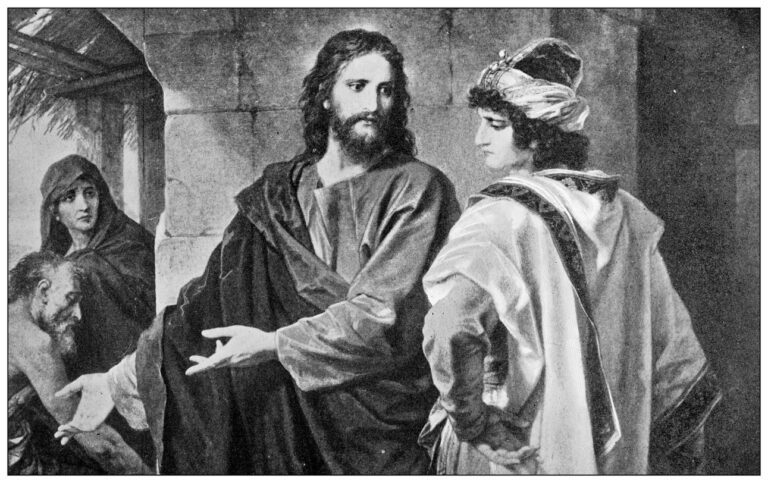
“No one is good except God alone” (Luke 18:19b). In the synoptic gospels, the Greek word translated as ‘good’ in English is agathŏs (pron. ag-ath-os′). It is a theocentric word. In other words, it refers to a being that is inherently ‘good,’ and therefore, that being’s acts are inherently good. Every good and perfect gift comes from God (Jas. 1:17). God is absolutely and perfectly good, and thus His actions are the same.
Agathŏs is distinguished from the Greek word kalŏs in that agathŏs reflects an inherent or intrinsic character to the person. Only God has the agathŏs attribute.
Kalŏs refers to created things or persons doing good. In other words, it refers to an action that is good but is done by a creature. The human being doing the good act may or may not be a Christian. If done by a Christian, it is a good work in God’s eyes because it is done for God’s glory. On the other hand, if the good act is NOT done for God’s glory, it will NOT be considered by God to be a good work.
Agathŏs and Kalŏs may be distinguished in the following way. Agathŏs refers to a person’s inner constitution or inherent goodness, i.e., God, whereas kalŏs, as an adverb, concerns the act itself. As an adjective, kalŏs refers to a good act of a creature. Whether Kalŏs is a good work or a civil good is determined by whether the actor is a Christian.
In the parable of the rich young ruler, for example, the good spoken of several times is a form of agathŏs. This good, spoken of by both the young man and Jesus, is the kindthat comes from a person seeking to do inherent good. This is the kind of good that is commanded by God. This is not the kind of good that any person can do; only a believer who seeks to glorify God can do it.
This parable appears only in the synoptic gospels, Matthew, Mark, and Luke, and the good written about in each book is a form of the Greek word agathŏs (Matt. 19:16-22, Mark 10:17-22, Luke 18:18-25). So, the young man and Jesus were talking about the same inherent goodness of God’s essence. They were talking about the kind of perfect good that comes from God and that He commands of believers.
The young man, though he appeared to be a decent person, was unwilling to do what Jesus (and God) required of him, which was to sell all his wealth, give the money to the poor, and follow Jesus. To do good work for God’s glory. He was unwilling to become a Christian and do the good works (kalŏs)of God (agathŏs) for the glory of God. Therefore, he left Jesus and His disciples as a non-Christian himself. The Bible doesn’t tell us whether he ever became a Christian. Nevertheless, he left Jesus as a non-Christian.
This is just one example in the Bible where the words agathŏs and kalŏs are used to show the Christian doing God’s good works for the glory of God rather than for the doer’s own glory.
