
Jesus selected Philip as one of His twelve apostles. We find Philip mentioned in several places in the Bible, in the gospels and once in Acts 1:13. But the Philip called “the apostle” is not the one this article discusses.
The Philip this article is about was a deacon in the early church. He later became an evangelist for the church. He is mentioned only in Acts (Acts 6:5, 8:5, 6, 12, 13, 26, 29, 30, 31, 34, 35, 37, 38, 39, 40, 21:8).
Before we discuss this article, let me give you some context.
ACTS 6:1-6
According to the Bible, there arose in the early church a dispute; it was charged that the Gentiles were neglecting the Jewish widows in the daily distribution of food, etc. The twelve apostles felt they would have to stop preaching as much to handle administrative matters. So they decided among themselves to choose seven men from Jesus’ disciples to handle these issues.
The twelve apostles called all the disciples together and told them they would select seven men from among them to handle these matters, and the disciples agreed. These men would be spiritual and wise and would have a good reputation among the disciples. The men they chose were: Stephen, Philip, Prochorus, Nicanor, Timon, Parmenas, and a former Jewish proselyte named Nicolaus. After praying and laying hands on them, the seven became deacons of the church and began carrying out their duties, which helped the apostles and solved the problem. These seven also became evangelists and preached, performing signs and wonders to the gatherings.
ACTS 6:8-7
It was during this time frame that the Jews and proselyte Jews seized Stephen, one of the seven deacons who had been preaching the Gospel of Jesus Christ. They could not stand what he was preaching, so they decided to tell other Jews that Stephen was preaching blasphemy. These Jews provoked the crowd and provided some false witnesses against Stephen.
In answer to these false charges, Stephen preached a sermon (see chapter 7). After the sermon, Stephen looked into heaven, and God let him see a preview of heaven, “where he saw the glory of God” and Jesus, “standing at the right hand of God.”
When the Jews heard Stephen’s sermon, “they were enraged.” They then took hold of Stephen and stoned him for blaspheming “Moses and God,” which of course he didn’t do. Saul of Tarsus was there and held the outer clothes of the false witnesses. The same Saul who later called himself Paul after he had converted to Christianity and became an apostle who preached and established churches for the Gospel of Christ.
ACTS 8:4-8
After Stephen’s death, Philip, another of the seven deacons appointed by the apostles, preached, performed signs and wonders, and evangelized on behalf of the Gospel of Christ in Samaria, and he created “much joy” there.
ACTS 8:26-40
You now have some context for the episode involving Philip the Evangelist and the Ethiopian eunuch. Now, let’s discuss this.
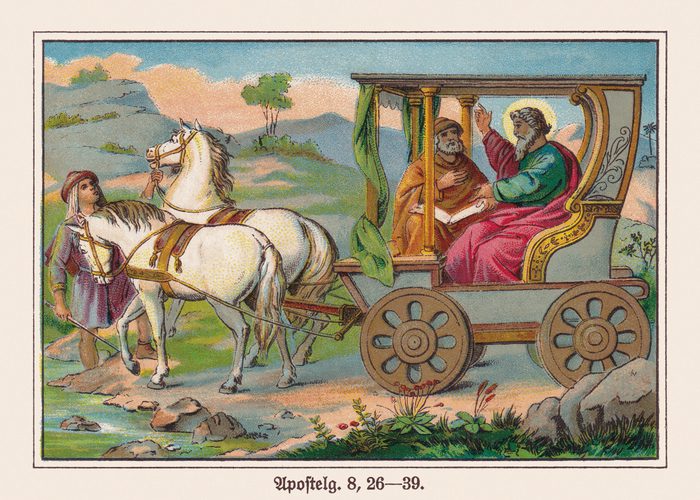
God spoke to Philip in Samaria through an angel, telling him to go south toward Gaza and that the road would take him through a desert place. While traveling on that road, Philip ran into an Ethiopian eunuch, a treasury official of the Queen of Ethiopia. The Ethiopian eunuch had been to Jerusalem to worship and was returning home.
The Ethiopian eunuch was reading a messianic passage in Isaiah 53:7, 8. The Holy Spirit directed Phillip to go to the eunuch’s chariot, and he asked him the question, “Do you understand what you are reading?” The eunuch responded by saying, “How can I, unless someone guides me?” So upon the eunuch’s invitation Philip joined him in the chariot.
The Ethiopian eunuch was confused by the Scripture he had read and did not know whom it was speaking about, so he asked Philip to interpret it for him. So Phillip, beginning with this question, told the eunuch about the Gospel of Jesus Christ
As they traveled on, they came to a body of water, and the eunuch asked Philip to baptize him. The eunuch and Phillip went down into the water; Philip baptized the eunuch, and they came up out of the water. Scripture does not tell us what mode of water baptism took place (pouring, sprinkling, or dipping, for example). Then the Holy Spirit took Philip away to Azotus, where he continued preaching and evangelizing. The Ethiopian eunuch continued on home.
CONCLUSION
The story of Philip and the Ethiopian eunuch appears in Acts 8:26-40. Philip was one of the seven deacons chosen by the twelve apostles, and he was also an evangelist. He is only mentioned in the book of Acts.
God directed Philip through an angel to go from Samaria through the desert on a road to Gaza. On this journey, under the Holy Spirit’s direction, he encountered the Ethiopian eunuch, a proselyte Jew. After discussing it with the eunuch, Philip converted him from Judaism to Christianity and baptized him in a body of water they came to. Then the Holy Spirit took Philip to Azotus, and the Ethiopian eunuch went on home.
This episode between Philip and the Ethiopian eunuch is significant in several ways:
- It confirms and executes Jesus’s command to the apostles (which also applies to the deacons and all Christians) found in Acts 1:8.
- It proves that God uses angels daily to transmit God’s Will to some humans.
- It shows that the Holy Spirit prompts Christians to do the things of God.
- This episode makes it clear that those who want to be Christians and Christians themselves should read Holy Scripture and that this Scripture should be explained and interpreted by the genuine preachers and teachers of the Gospel of Christ.
- Every person who wants to become a Christian must approach the Gospel of Christ with humility, and it is clear that the Ethiopian eunuch had the humility required.
- The eunuch was from a country in Africa, a proselyte Jew, and a man of influence, showing the cultural variety of Christian converts.
- The importance of the church and the utilization of Christian gifts from God to spread the message of the Gospel of Christ is evident in this passage.
